Building the Capability for Permanent Human Civilization Beyond Earth
The McKinley Consortium is a public-private initiative dedicated to designing, building, and operating the infrastructure, industrial capacity, and institutional foundations required for sustained and permanent non-terrestrial existence.
From Presence to Permanence
For more than half a century, humanity's activity beyond Earth has been defined by missions, demonstrations, and temporary presence. The next chapter requires something different: durable capability. Permanent non-terrestrial civilization will not emerge from isolated missions alone. It requires industrial systems, habitable infrastructure, governance frameworks, commercial models, standards, and institutions built for continuity.
The McKinley Consortium exists to accelerate that transition. We are forming a coalition of public and private stakeholders to create the practical foundations of long-duration off-world life — not merely survival, but the capacity for communities, institutions, and economies to endure and expand beyond Earth.
Why Humanity Needs a Durable Off-World Future
Civilizational Resilience
Human civilization remains concentrated on a single world. A resilient future requires distributed human presence and productive capacity beyond Earth.
Permanent Capability
Exploration alone is not enough. The future depends on systems that can be maintained, expanded, governed, financed, and operated over generations.
Industrial Expansion
Large-scale off-world existence requires in-space construction, materials processing, logistics, and infrastructure at a fundamentally different scale.
Human Flourishing
Permanence requires more than airtight habitats. It requires safety, dignity, privacy, health, meaningful work, social institutions, and long-term quality of life.
Public-Private Coordination
No single company or agency can build the next phase of civilization alone. Progress will require aligned participation across governments, industry, research, and capital.
Benefit to Earth
The technologies, systems, and institutions developed for sustained off-world life can also strengthen terrestrial infrastructure, resilience, manufacturing, and scientific capability.
"To ensure the long-term future of humanity by creating and operating the capability for sustained and permanent non-terrestrial existence, and by developing the technical, industrial, governance, and economic foundations required for participants and their successors to achieve a quality of life equal to or greater than that available on Earth."
— Article II, Core Mission, Charter of the McKinley Consortium
McKinley Station: The First Orbital Industrial Civilization Platform
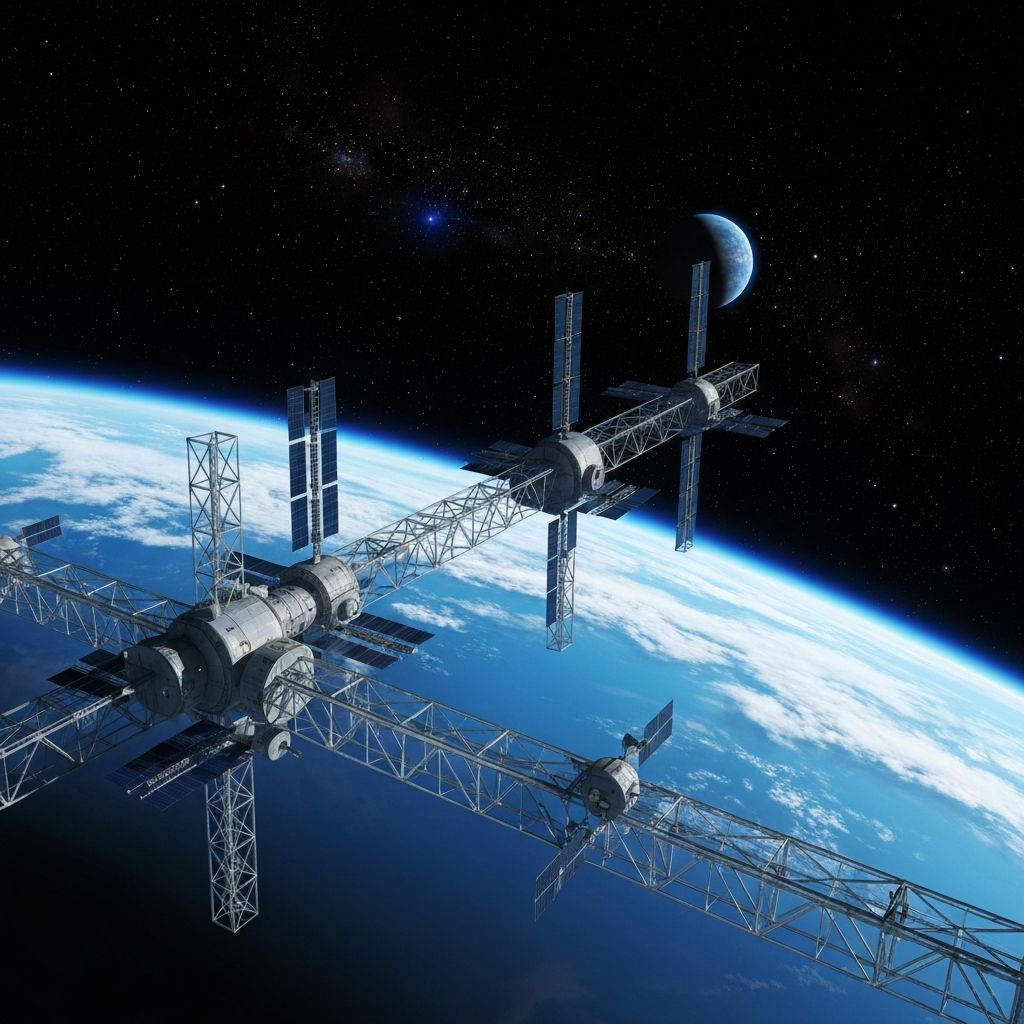
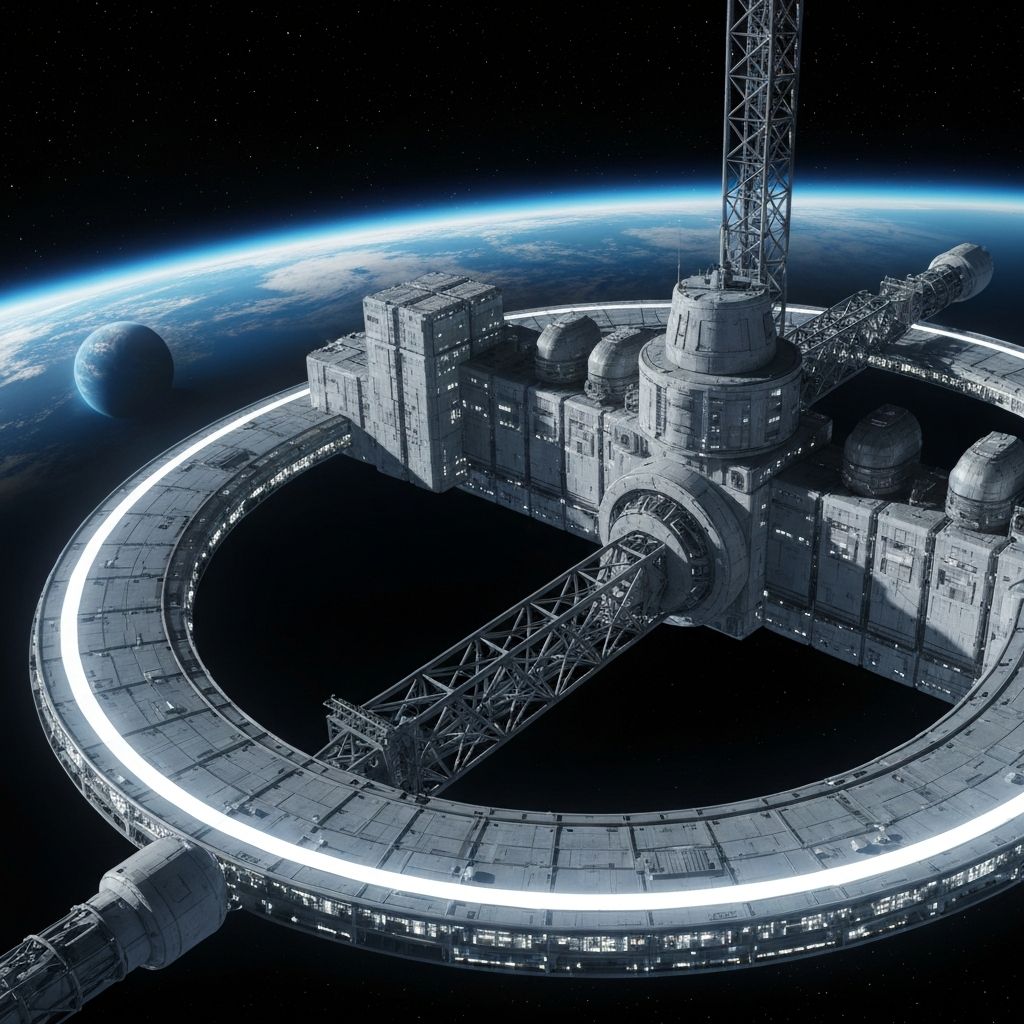
At the center of the Consortium's public vision is McKinley Station — an orbital industrial and habitation platform designed to support in-space construction, materials processing, assembly, logistics, and the staged expansion of permanent human activity beyond Earth.
Rather than treating orbit as a temporary outpost environment, McKinley Station is conceived as a foundational piece of future industrial civilization: a place where Earth-manufactured precision systems and space-manufactured bulk structure come together to enable larger, more capable, more durable infrastructure than launch-constrained architectures allow.
Five Pillars of Permanent Civilization
Infrastructure
Habitats, utilities, logistics systems, docking systems, safety architecture, thermal systems, and long-duration operational support.
Industry
Resource extraction, refining, in-space manufacturing, structural fabrication, assembly, maintenance, recycling, and expansion of off-world productive capacity.
Governance
Operating rules, rights and responsibilities, institutional continuity, standards, dispute resolution, and public-interest stewardship.
Quality of Life
Health, privacy, safety, education, recreation, family life, cultural continuity, and human-centered design for permanent communities.
Economic Participation
Public-private financing, commercial operating models, strategic partnerships, infrastructure participation, and long-horizon development frameworks.
Who the Consortium Is For
Membership DetailsGovernments & Public Agencies
Public institutions play a foundational role in authorizing, funding, and enabling the next phase of human activity beyond Earth. The Consortium provides a structured mechanism for governments to participate in long-horizon off-world development alongside industrial and research partners — ensuring national interests, public safety, and international coordination remain central to the enterprise.
Aerospace & Industrial Companies
From launch providers and habitat manufacturers to energy, robotics, and construction firms, the Consortium provides a collaborative framework for industrial participants to shape standards, secure program participation, and help define the architecture of permanent non-terrestrial infrastructure. Early participation means early influence over specifications, standards, and procurement frameworks.
Universities & Research Institutions
The scientific and engineering challenges of permanent off-world civilization represent one of the most consequential research frontiers of the coming century. Universities and research organizations can contribute to technical working groups, help define standards and qualification regimes, and participate in a mission that will shape academic and industrial research for generations.
Capital Providers & Philanthropic Backers
Permanent non-terrestrial civilization requires long-horizon capital aligned with durable outcomes rather than short-cycle returns. The Consortium is designed to engage sophisticated investors, infrastructure funds, and philanthropic foundations willing to make commitments calibrated to the scale and time horizons appropriate to a generational infrastructure program.
Standards Bodies & Civil Institutions
The governance, certification, and operational safety requirements of permanent off-world communities will require rigorous standards work. Standards organizations, professional societies, and civil institutions are invited to participate in the development of qualification regimes, operational frameworks, and governance structures appropriate to permanent non-terrestrial life.
Future Operators, Builders & Workforce Participants
The people who will build, operate, and inhabit permanent off-world infrastructure will be trained by the institutions and programs that exist today. The Consortium is committed to developing workforce pathways, training frameworks, and educational partnerships that prepare the next generation for roles in off-world construction, operations, science, and governance.
Read the Founding Charter
The Charter of the McKinley Consortium defines the mission, principles, strategic objectives, governance direction, and public purpose of the initiative. It establishes a clear commitment to permanence, safety, human flourishing, institutional seriousness, and long-horizon development beyond Earth.
Read the Full CharterJoin the Initiative That Moves Humanity from Presence to Permanence
The challenge of permanent non-terrestrial civilization will not be solved by aspiration alone. It will be solved by institutions willing to align mission, capital, engineering, governance, and operational discipline over decades. The McKinley Consortium is being formed to do exactly that.