McKinley Station
An orbital industrial and habitation platform designed to help move humanity from temporary presence to permanent capability beyond Earth.
A Platform for Industrial Civilization, Not Just Habitation
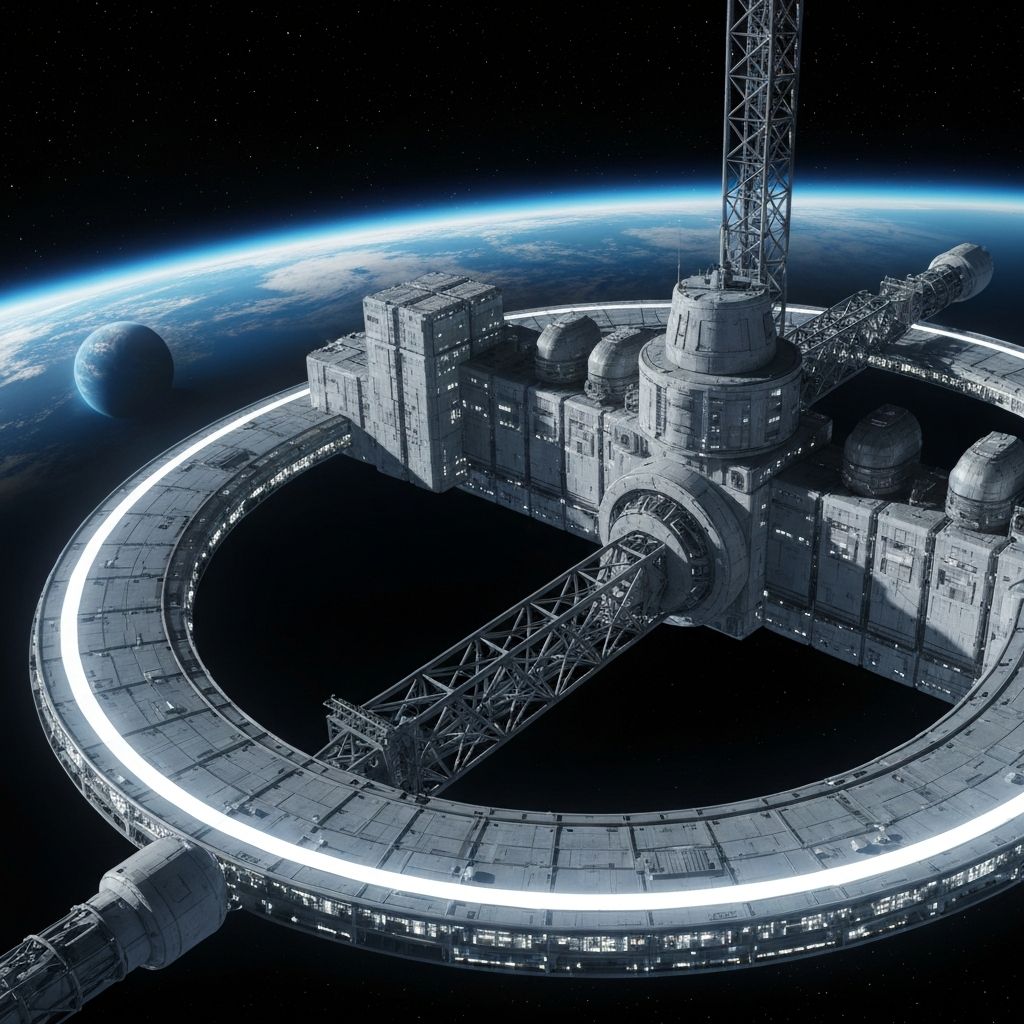
McKinley Station is envisioned as a foundational orbital platform for the next phase of human development beyond Earth. It is not conceived merely as a destination, laboratory, or temporary outpost, but as a practical industrial and civic platform — a place where infrastructure, manufacturing, logistics, and long-duration human presence can begin to scale together.
Permanent civilization needs more than launch vehicles and isolated habitats. It needs places where infrastructure can be assembled, maintained, expanded, and operated over time. McKinley Station is designed to be that place: a durable orbital node where the building blocks of off-world civilization can actually be built.
Why It Matters
McKinley Station represents a shift in strategic posture. Instead of treating orbit as a temporary place to visit, it treats orbit as a place to build. That shift has implications for habitation, industry, resilience, science, logistics, infrastructure scale, and the long-term normalization of human life beyond Earth.
Explore McTwinley — Our Orbital Digital Twin Platform
McTwinley is a browser-based simulation and command environment for McKinley Station. Inspect live telemetry, model station systems, run emergency scenarios, build station layouts in 2D, and visualize critical systems in 3D — all in your browser.
Core Operational Capabilities
In-Space Construction
McKinley Station provides the structural framework and tooling base for assembling large-scale infrastructure that cannot be launched as a single payload. Orbital construction enables structures far beyond the mass and volume constraints of any existing or planned launch system.
Materials Processing
A dedicated foundry and materials processing facility enables the refining of space-sourced feedstocks — reducing dependence on Earth-origin bulk materials and beginning the transition to genuine orbital industrialization.
Orbital Assembly
Precision assembly yards allow Earth-manufactured high-value components and space-processed structural materials to be integrated into larger systems: habitats, propulsion architectures, power stations, and future infrastructure.
Logistics & Servicing
A purpose-built logistics hub and docking architecture enables resupply, crew rotation, vehicle servicing, component delivery, and outbound distribution to other destinations. Logistics is the connective tissue of off-world civilization.
Habitat Expansion
McKinley Station is designed to grow. Starting with a minimum operational configuration, the station architecture accommodates progressive addition of habitat modules, expanded crew capacity, recreation facilities, and community infrastructure.
Governance & Community
Permanent presence requires more than operations. McKinley Station includes provisions for community governance, dispute resolution, social infrastructure, and the institutional frameworks that distinguish a permanent community from a temporary deployment.
Conceptual Module Architecture
The following conceptual modules represent the primary functional zones of McKinley Station in its initial and intermediate configurations. Specific architecture will be defined through the Consortium's technical working groups and standards development process.
Crew / Operations Core
The primary habitation, command, and life-support hub. Houses crew quarters, command center, medical facilities, and primary life-support systems.
Utility Spine
Central structural and utility backbone connecting all modules. Provides power distribution, thermal management pathways, communications routing, and structural integration.
Feedstock Dock
Specialized docking and handling facilities for receiving bulk feedstock materials from mining operations, Earth supply missions, and propellant deliveries.
Foundry & Materials Works
Processing and refining modules for converting raw feedstock into usable structural materials, alloys, and industrial inputs for fabrication operations.
Fabrication & Welding Bays
Large-volume fabrication and joining facilities for producing structural components, pressure vessels, truss sections, and custom industrial parts.
Inspection & Qualification
Non-destructive evaluation, dimensional inspection, materials testing, and qualification facilities to ensure structural and system integrity of all produced components.
Large Assembly Yard
Open-frame external assembly area for integrating large structures that cannot be assembled inside enclosed bays. Includes robotic handling and human-tended assembly operations.
Thermal & Power Wings
Extensive solar power arrays and radiator systems providing primary electrical power and thermal management for all station operations.
Habitat Works & Shielded Expansion
Progressive expansion zones for adding new habitation capacity, including radiation shielding structures, pressurized living quarters, and community amenity spaces.
A Staged Path to Industrial Scale
Earth-Built Foundation
The initial station configuration is delivered via multiple Earth launches: precision systems, life support, utilities, and core operational infrastructure. This establishes the minimum viable operational platform.
Orbital Construction Capability
Early operations focus on developing and proving orbital construction techniques, tooling, robotic systems, and human-tended assembly procedures. The station becomes a working construction facility.
Industrial Materials Processing
Feedstock from early mining and supply operations begins processing through the foundry. The station produces its first space-origin structural components, beginning the reduction of Earth-supply dependency.
Growing Non-Terrestrial Manufacturing Share
Increasing share of structural material is produced in orbit. New capacity is added using locally manufactured components, reducing cost per added volume and enabling more ambitious expansion.
Permanent Community Scale
The station grows beyond operational crew into a genuine community with rotating and permanent residents, recreational and educational facilities, governance institutions, and quality of life features consistent with long-term habitation.
Participate in the Architecture of McKinley Station
Technical, industrial, governmental, and research organizations are invited to participate in the program definition and architecture standards process.